
AI agents don’t fit neatly into your org chart
In this article we explore Uber’s “Agentic Pods” model, where AI engineers are paired with subject-matter experts to redesign real business workflows. The approach highlights a broader challenge for enterprises: agents often work across systems and functions, while most organisations are still managed in silos. We look at why these pods work, where they fall short, and what a practical operating model for AI agents could look like.
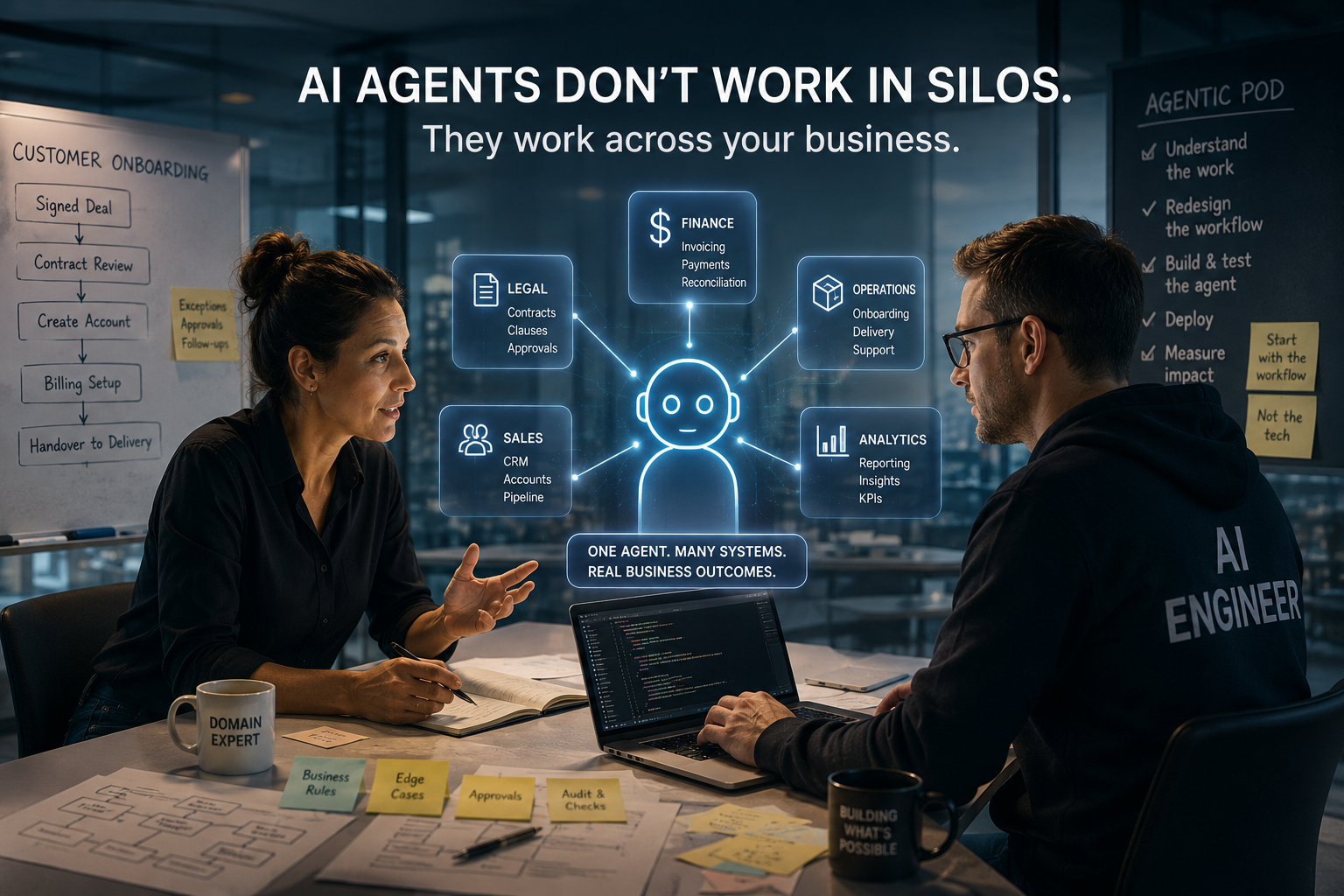
What Uber’s Agentic Pods can teach us about deploying AI across a business
Most companies are organised vertically.
Finance manages finance. Legal manages legal. HR manages HR. Technology manages technology.
But business processes rarely stay inside one of these boxes.
Signing a new customer might involve sales, legal, finance, delivery and operations. Hiring an employee might involve HR, IT, payroll, security and the hiring manager.
The more useful an AI agent becomes, the more likely it is to cross these organisational boundaries.
This creates a practical problem: who owns it?
Uber’s Agentic Pods
Uber has been experimenting with a model it calls Agentic Pods.
The company reportedly selected around 30 of its most AI-proficient engineers and embedded them in functions including finance, HR and legal. The engineers worked directly with subject-matter experts, observed how the work was actually done and built agents around those workflows.
The reported results are impressive.
A financial pacing report that previously took two days can now be completed in ten minutes. Another process for allocating capital across 150 cities reportedly fell from 15 hours to around 30 minutes.
But the speed improvements are not the most interesting part of the story.
The interesting part is the structure Uber created to find them.
Uber did not ask a central AI team to review a process document, disappear for three months and return with a finished system. It put engineers directly alongside the people doing the work.
Agents follow workflows, not organisational charts
Most enterprise technology is purchased and managed by a particular department.
Sales owns the CRM. Finance owns the accounting platform. HR owns the employee system.
Agents are different.
An agent tasked with onboarding a new customer might need to read an agreement, identify unusual terms, create CRM records, initiate billing, prepare a delivery brief and request missing information.
From the customer’s perspective, this is one process.
Inside the company, it may involve five teams, six systems and a collection of spreadsheets, emails and undocumented business rules.
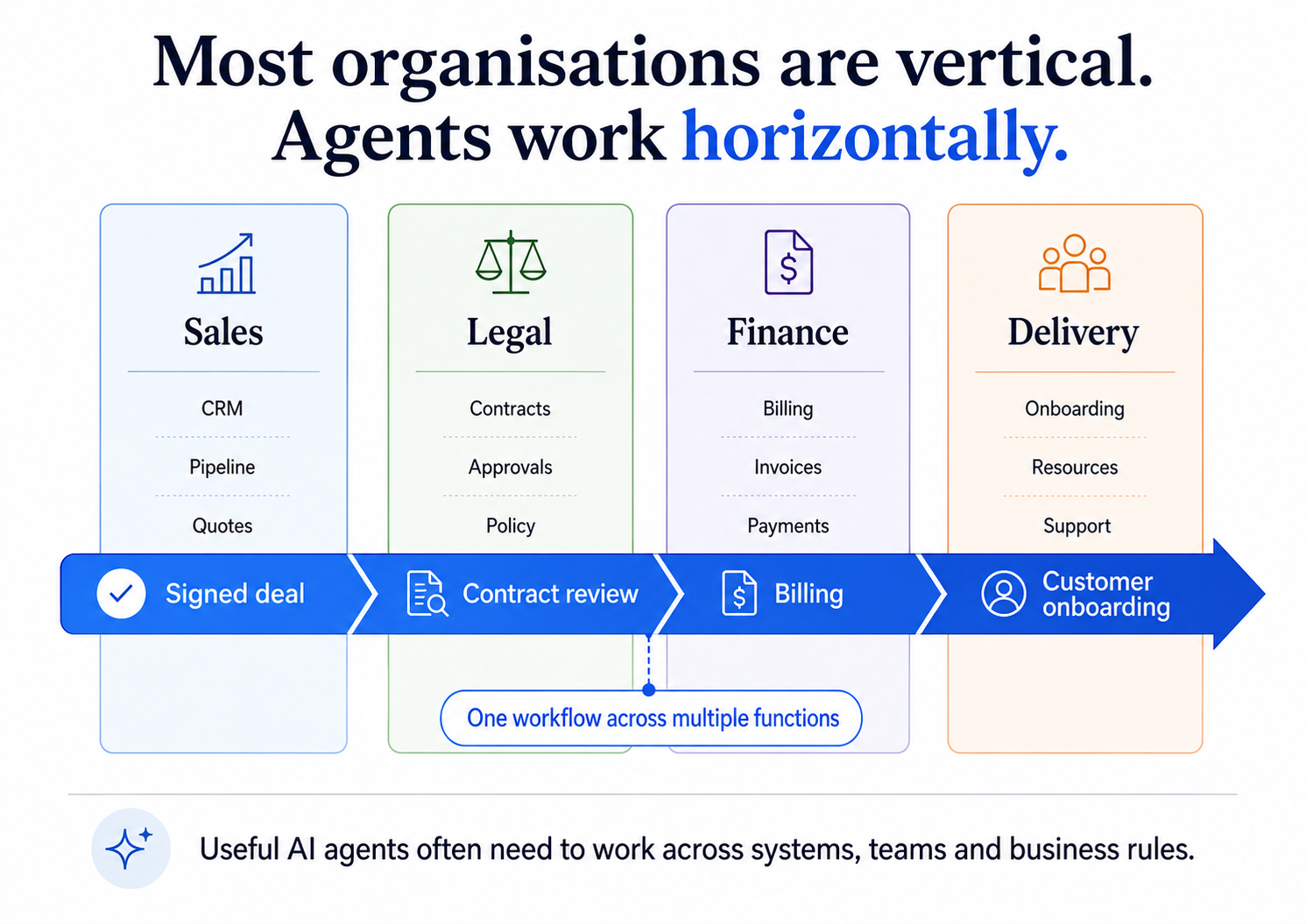
This is why apparently straightforward agent projects can become difficult.
The model may be capable of performing the individual tasks. The harder questions are organisational.
Which team’s rules take priority? Where is human approval required? Who handles exceptions? What happens when making one department more efficient creates more work for another?
These are operating-model questions, not model questions.
Why the engineer and subject-matter expert pairing works
The Agentic Pod model brings together two types of knowledge that are usually separated.
The engineer understands the models, tools, integrations and technical guardrails.
The subject-matter expert understands how the work really happens.
They know which spreadsheet is actually used rather than the system that is supposed to be used. They know why a particular approval exists, which exceptions occur regularly and which decisions require judgement.
Neither side has the complete picture on its own.
An engineer working from a process diagram may automate the official version of the workflow rather than the real one.
A subject-matter expert may know exactly what is broken but not recognise which parts can now be delegated to an agent.
Putting them together allows the team to redesign the work rather than simply add AI to the existing process.
The question changes from:
Where could we add AI?
To:
If we could redesign this process today, how should it work?
Pods solve the building problem
Uber’s approach looks like a strong model for discovering opportunities and getting agents into production.
But the pod is temporary. The agent is not.
Once the engagement ends, someone still needs to own its performance, update its instructions, manage exceptions and remain accountable for the business outcome.
A central AI team should probably not own every agent in the organisation. It is too far removed from the work and will quickly become a bottleneck.
But handing an agent back to one department can also be difficult when the workflow crosses several functions.
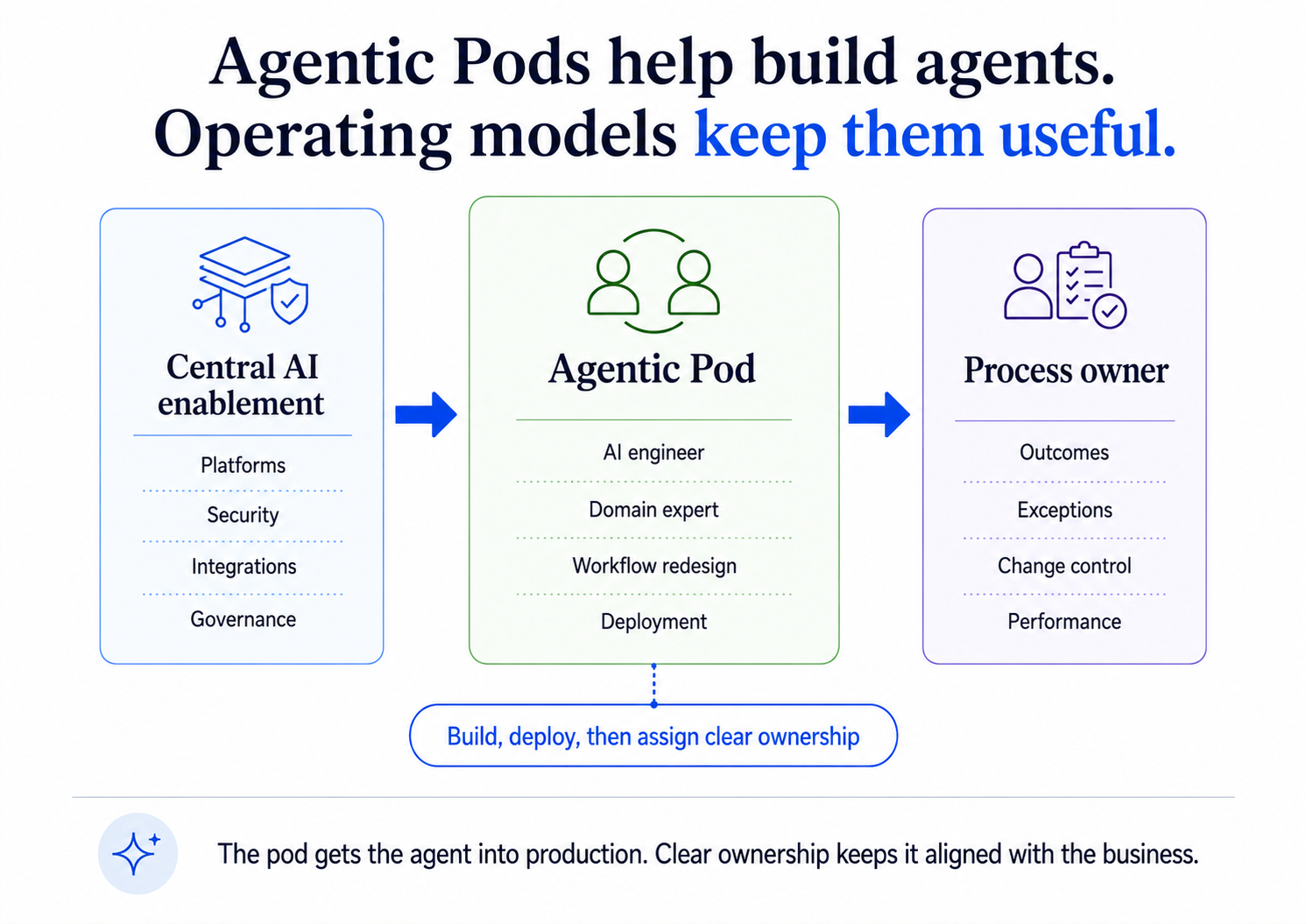
Agentic Pods are a delivery model. They are not the complete agent operating model.
A practical model has three parts:
A central AI team provides platforms, security, integrations and governance.
Small pods bring engineers and domain experts together to redesign workflows.
A named process owner remains accountable once the agent is deployed.
That final part matters.
An onboarding agent should not be measured by the number of documents it processed or tokens it consumed. It should be measured by whether customers are onboarded faster, with fewer errors and less manual effort.
What this means for your business
Do not start by asking every department to produce a long list of possible agents.
Start with one meaningful workflow.
Choose something that involves repetitive coordination, moves through multiple systems and has an outcome the business already cares about.
Pair someone who deeply understands the work with someone who understands what agents can now do.
Give them enough access to observe the real process, including its exceptions and unofficial workarounds.
Then decide who will own the agent before it goes live.
Uber’s Agentic Pods show that the best opportunities may not be found inside a central innovation lab. They are buried inside the day-to-day work of finance teams, operations teams, lawyers, marketers and customer service staff.
The winners will not necessarily be the companies with access to the smartest models.
They will be the companies that become best at bringing technical and domain expertise together, redesigning work across organisational boundaries and giving the resulting agents clear ownership.
Agents may be digital workers.
But they still need a manager.