
The AI jobs crash that hasn’t happened
The question I hear more than any other about AI is simple: “Is it going to take my job?”
New Australian research gives a reassuring answer: not so far.
The Department of Employment and Workplace Relations has just released its first AI and Employment in Australia report. It tracks employment outcomes since ChatGPT arrived in late 2022, and finds no evidence of broad AI-driven labour market upheaval.
Australia’s overall labour market remains resilient. Employment among 20 to 24-year-olds has grown slightly faster than for older workers, young graduate unemployment remains low, and there has been no unusual reshuffling of jobs between occupations.
That does not mean every signal is positive. Jobs in the fifth of occupations most exposed to AI grew by 5.6% between November 2022 and February 2026, compared with 9.5% in the least-exposed fifth. The Department’s modelling estimates that an occupation with above-average AI exposure had employment around 2% below its pre-ChatGPT trend by February.
Importantly, the Department is careful not to overstate this. The result is sensitive to modelling choices, and the report says it is an early sign of modestly slower growth in some exposed occupations, not proof of widespread AI-driven job loss.
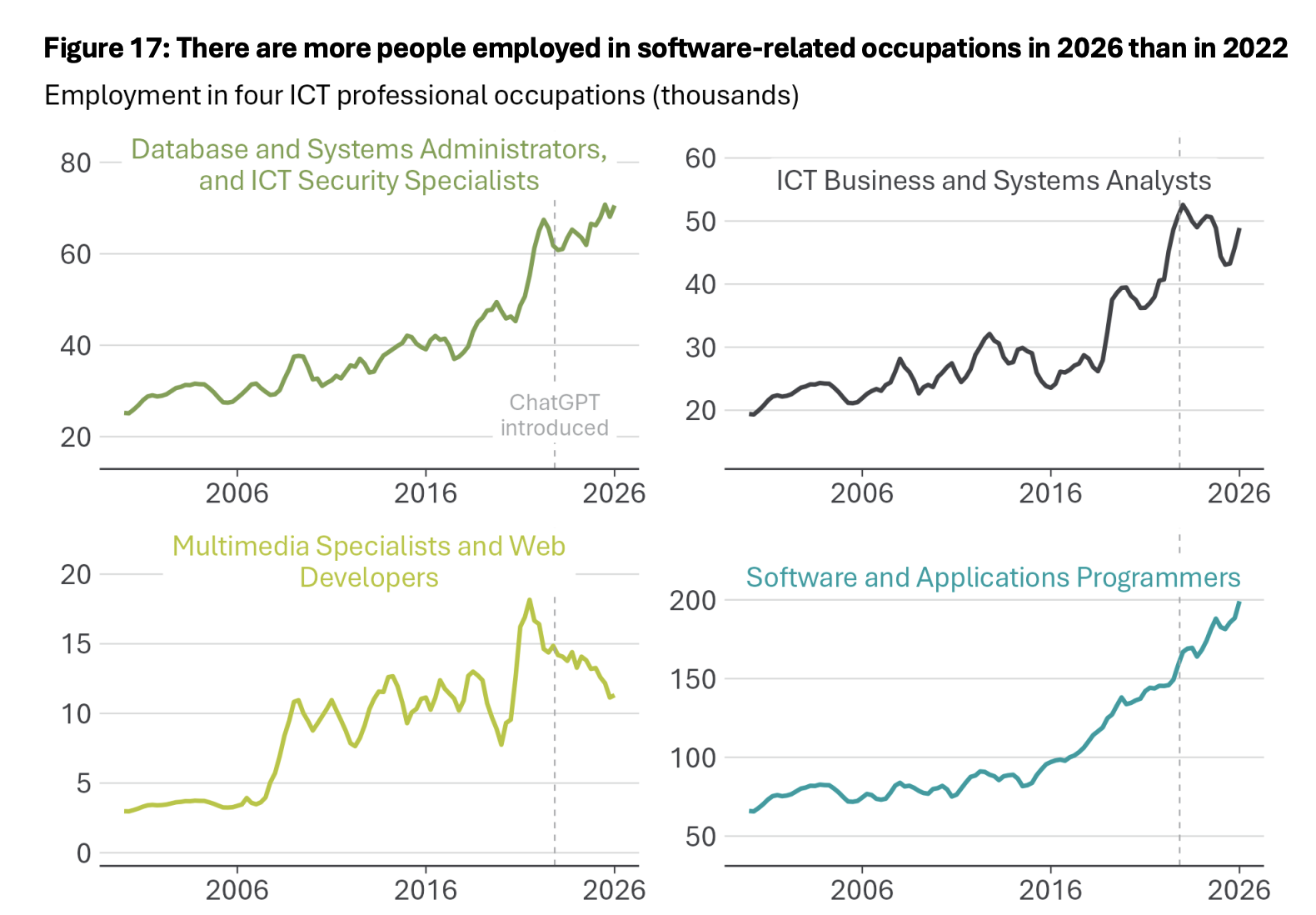
There are also some counterintuitive Australian results. Software and Applications Programmers, one of the occupations most exposed to AI, grew 25% over the same period. So “exposed to AI” does not automatically mean “being replaced by AI”.
The emerging global evidence points in a similar direction. A new Ramp and Revelio Labs study linked observed AI spending with workforce data across more than 21,000 US firms. Companies making the largest AI investments grew headcount by 10.2% over the two years after adoption, including 12% growth in entry-level headcount. Lower-intensity adopters saw no statistically significant change.
This is correlation, not a promise that buying AI tools creates jobs. Those firms were already larger, more technical and faster-growing. But it is a useful reminder that businesses do not have to use productivity gains only to cut costs. They can use them to serve more customers, launch new products and grow.
PwC’s 2026 Global AI Jobs Barometer, based on more than one billion job advertisements across 27 countries, also found faster headcount growth in the most AI-exposed companies than the least exposed: 52% versus 36% since 2018. It found that roles requiring AI skills carry a 62% average wage premium.
My view is that people who use AI well become more valuable to a business. They get more done, make better use of their judgement, and can create more value for customers. Employers want valuable workers. If companies channel that extra capacity into growth rather than simply fewer people, AI could become a driver of jobs growth, not just efficiency.
The evidence is early. But the story so far is less “AI takes jobs” and more “AI changes what valuable work looks like”.