
Five Good Friends: transforming aged care member experience
Five Good Friends (FGF) is transforming how Australians access aged care and home support services. As CEO Simon Lockyer and his team prepared for a major digital refresh ahead of significant regulatory changes in the industry, they recognised that generative AI could fundamentally improve how prospective members discover and engage with FGF's services.
Rather than bolt AI onto existing systems, they wanted to build AI capabilities into the foundation of their new digital presence. Our brief: help FGF identify the highest-impact use cases, rebuild their website with AI at its core, and deliver a conversational assistant that would serve as a genuine "front door" to their services.
Through a multi-phase engagement spanning strategy, design and development, we helped Five Good Friends deliver an AI-powered digital experience that makes finding aged care support easier and more personalised for every prospective member.

"Time Under Tension has been instrumental in transforming how we think about and implement generative AI at Five Good Friends. From our initial Gen AI Design Sprint that mapped out our strategy, through to our rapid website rebuild using an AI-first approach, they've consistently delivered beyond expectations.
"The AI Help Planner they created is genuinely innovative – helping our prospective members design personalised help packages through a simple conversation. What sets them apart is their ability to move fast without sacrificing quality, and their knack for translating complex AI capabilities into practical solutions that make a real difference for our business and our members." - Simon Lockyer, CEO, Five Good Friends
Our vision statement
"Make finding the right aged care support as simple as having a conversation with a knowledgeable friend who understands your needs and budget."
Generative AI Design Sprint
We took FGF through our Generative AI Design Sprint to accelerate AI-driven transformation. The sprint comprised three key elements:
Inform session: A presentation familiarising the entire FGF team with generative AI's impact on their sector and the wider home care industry.
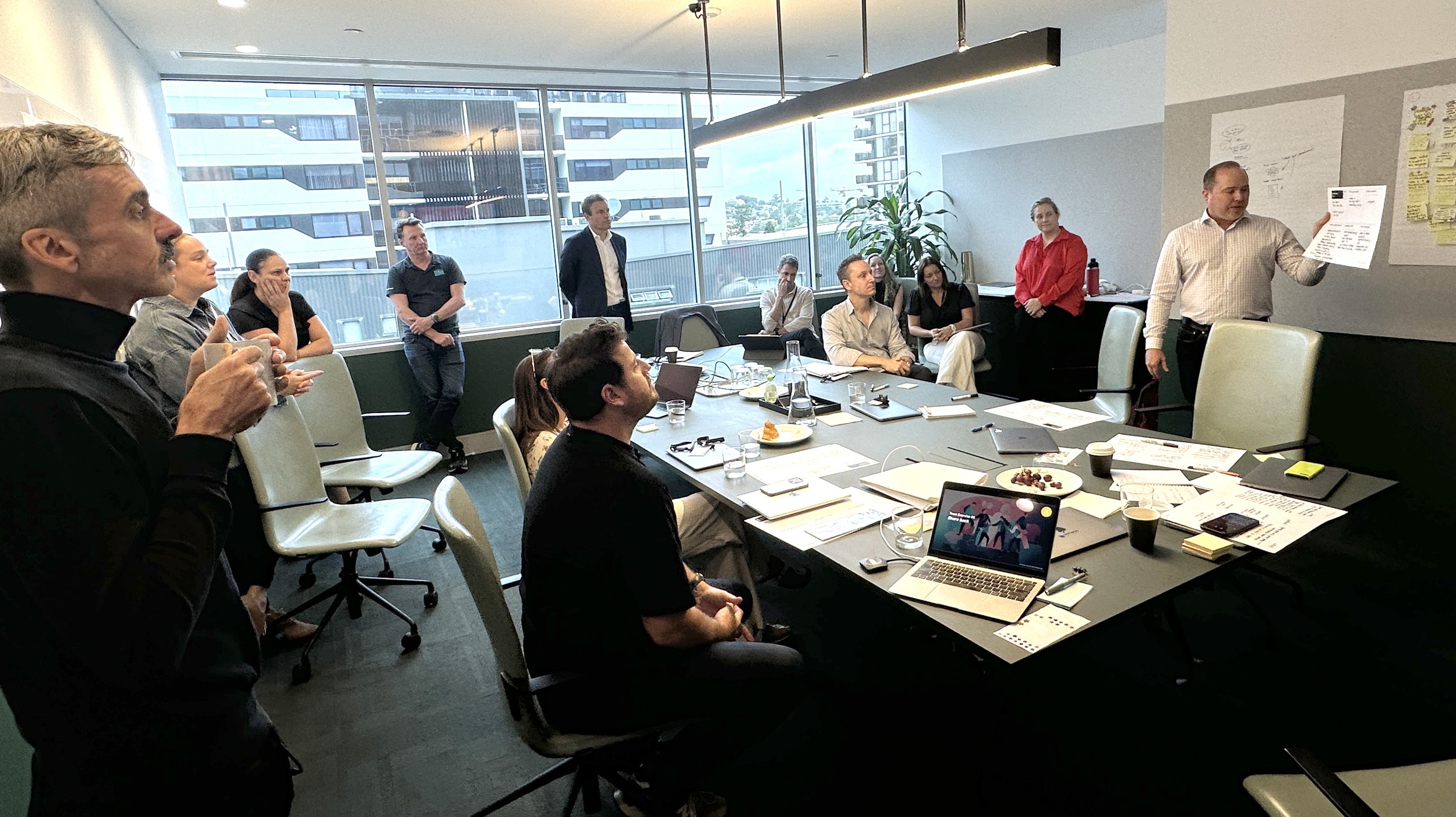
Design workshop: An in-person workshop focusing on marketing and customer experience use cases. Using structured design-thinking exercises, we identified and prioritised transformative AI applications across FGF's member journey.
Proof of Concept: We developed one of the high-priority use cases into a functional prototype over two weeks, demonstrating feasibility and building internal momentum.
The output was also a comprehensive AI Roadmap with prioritised use cases and recommendations for how to bring the ideas to life.
Key outcome: Clear strategic direction with executive buy-in and a working prototype that proved the concept.
AI-first website rebuild
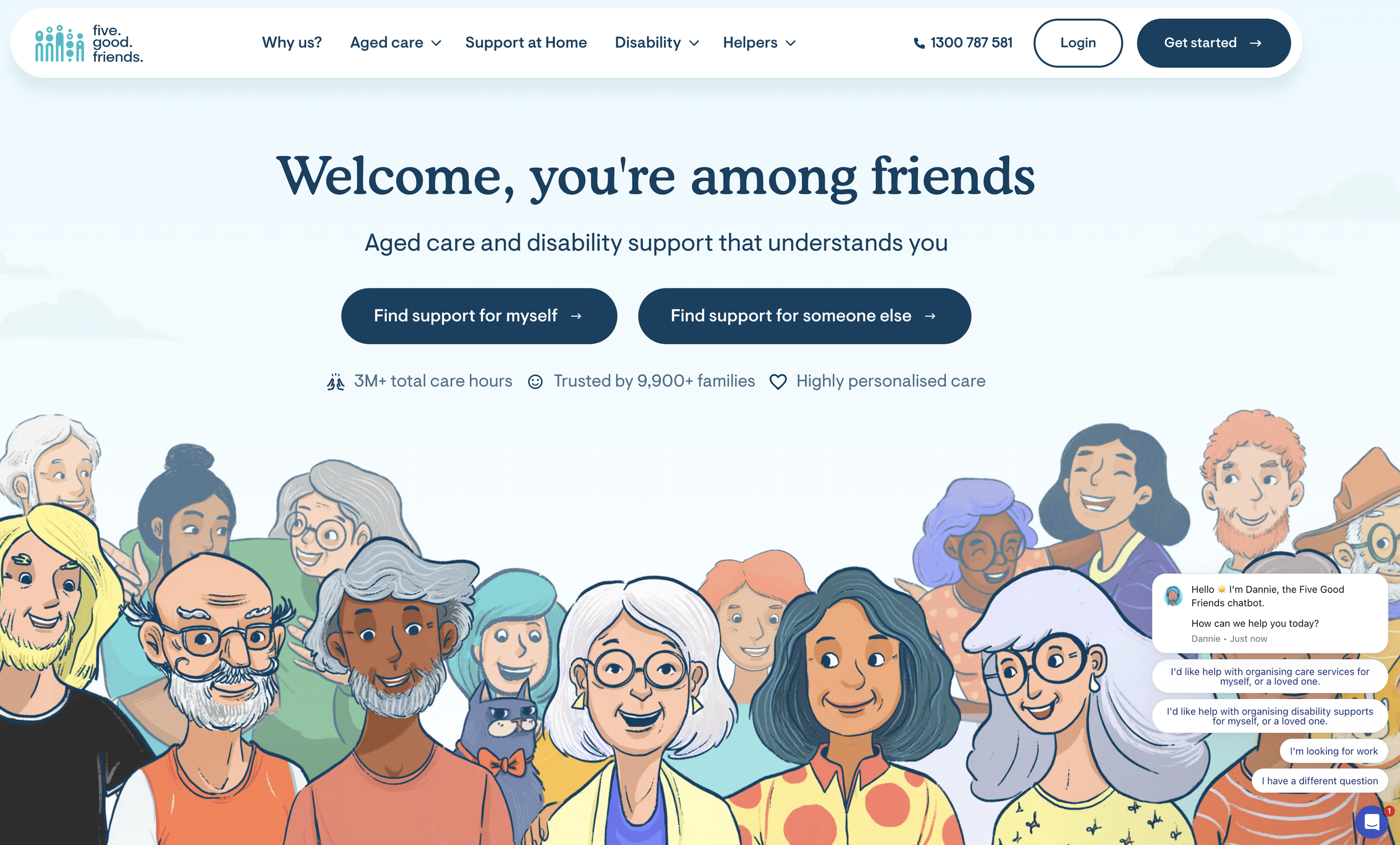
With the roadmap in hand, we moved into implementation, redesigning and redeveloping FGF's marketing website ahead of the regulatory change deadline.
Discovery and scoping: UX research, sitemap creation, content planning and CMS integration strategy to ensure the new site would serve as an effective "front door" for prospective members. We used AI heavily to assist us in this phase, including vibe-coding a content audit app!
Design and build: UI design, Webflow development, component creation (including a Support at Home Budget Calculator), and a design system that FGF's internal team could manage independently. The approach prioritised conversion optimisation to improve member acquisition.
Technology planning: We developed a comprehensive plan for CMS integration that would enable FGF staff to maintain and evolve the site without ongoing agency dependency.
The project scope was carefully defined to focus on the marketing website and key landing pages, with additional pages designed to be migrated by FGF's internal team using the components and design system we created.
Key outcome: A modern, conversion-optimised website built on a flexible foundation for future AI enhancements.
AI Help Planner
Following the successful website launch, we moved to implement the standout use case from the Design Sprint: a generative AI chatbot to serve as a lead magnet and provide prospective members with a signature experience.
The AI Help Planner guides prospective members through a short conversational experience, then generates tailored care plans for FGF services within their budget. This transforms what would traditionally require multiple phone calls or form submissions into an engaging, immediate experience.
Summary
From initial Design Sprint to live AI assistant, FGF moved from AI strategy to sophisticated implementation in under 12 months. The CEO and leadership team remained closely involved throughout, with FGF staff collaborating on design, content and testing to build internal AI capability alongside the delivered solutions.
This engagement succeeded because FGF approached AI transformation strategically rather than tactically. By investing in the Design Sprint upfront, we identified use cases collaboratively, built internal buy-in, and created a sequenced roadmap that delivered value at each phase. The website rebuild wasn't just a refresh; it was designed from the ground up to support AI integration. And the AI Care Plans tool wasn't a bolt-on chatbot; it was purpose-built to solve a specific member acquisition challenge identified in discovery.
Most importantly, FGF viewed Time Under Tension as a true partner, not just a vendor. CEO Simon Lockyer and his team remained engaged throughout, participated actively in workshops, provided timely feedback, and invested in building their own AI capabilities alongside our development work. The result is a foundation for ongoing AI innovation across FGF's business, with the marketing experience serving as proof of what's possible.