
Does your marketing team need an infinity machine?
Ten years ago Deepmind built an infinity machine - an AI system to master Go. Last week Adobe announced their infinity machine for marketing - it’s called Adobe CX Enterprise.
Last week on my flight to Las Vegas for the Adobe Summit (their headline event for martech products) I was reading The Infinity Machine, a biography on Denis Hassabis the co-founder of DeepMind. One of the major breakthroughs from DeepMind was creating an artificial neural network (a deep learning method) that in 2016 beat one of the world’s best players at the board game Go.
This was newsworthy because mastering Go is notoriously difficult - a game has roughly 10170 possible positions, more than the number of atoms in the universe. Because of the overwhelming possibilities, AI is now better at Go than even the best humans.
“Overwhelming possibilities” was also a common theme across my three days at the Adobe Summit (which I attended as a guest of Adobe).
At the event I kept hearing about the pressure that marketers are facing with the increased complexity and volume of content that is required - due to proliferation of new marketing channels, the speed of consumption on channels (in particular TikTok where content can last just a few moments) and the desire to personalise content for individuals.
And it’s about to become even more overwhelming; according to Adobe “content demand is expected to increase by 5x over the next two years”. Or as Procter & Gamble’s CEO put it in his keynote:
“Today, we’re making hundreds of pieces of content every day, either in a brand voice, in a consumer voice or with an expert voice.
“Just to manage that scale of content, you cannot do it physically. You cannot do it humanly. And so AI becomes not a nice to have. It is a necessity.”
A decade ago, marketing was like playing chess. Now being a modern CMO requires the skills to master complexity like that of Go. And they will need AI to have a chance at keeping pace.

A typical chess turn has an average of about possible 35 moves, whereas a Go turn offers over 200 possible moves
The marketing infinity machine
Since the launch of ChatGPT three years ago, customer expectations have changed. We now expect to research any product in ChatGPT, have conversational experiences on a brand’s website, and have personalised content served to us.
Adobe CX Enterprise is a new suite of products, that is addressing these changing expectations with solutions for;
Brand visibility - to measure and optimise websites for visibility in AI chatbots
Customer engagement - to manage and personalise the content on digital experiences
Content creation - workflows for the creation and post-production of marketing assets (e.g. product images, campaign graphics)
As you will have guessed by now, this is all powered by AI, with what Adobe (appropriately enough) have named the Adobe AI Platform. And this is the part that surprised me the most. In fact, I even lost a bet to a friend thinking they would NOT launch this!
Build, run and deploy CX agents
Within CX Enterprise you can build agentic workflows that follow a process to complete a goal. For example, we saw a demo for Dick’s Sporting Goods with a ‘Catalog Agent’ optimising product metadata to improve visibility inside ChatGPT.
You can also run agents using in the new CX Enterprise Coworker product, which is similar to a Claude Cowork or OpenAI Codex, but for your marketing and CX agentic workflows. In fact, the closest comparison is the new Microsoft Copilot Cowork app - which is a browser based coworker (as opposed to Anthropic and OpenAI’s coworkers which are desktop software).
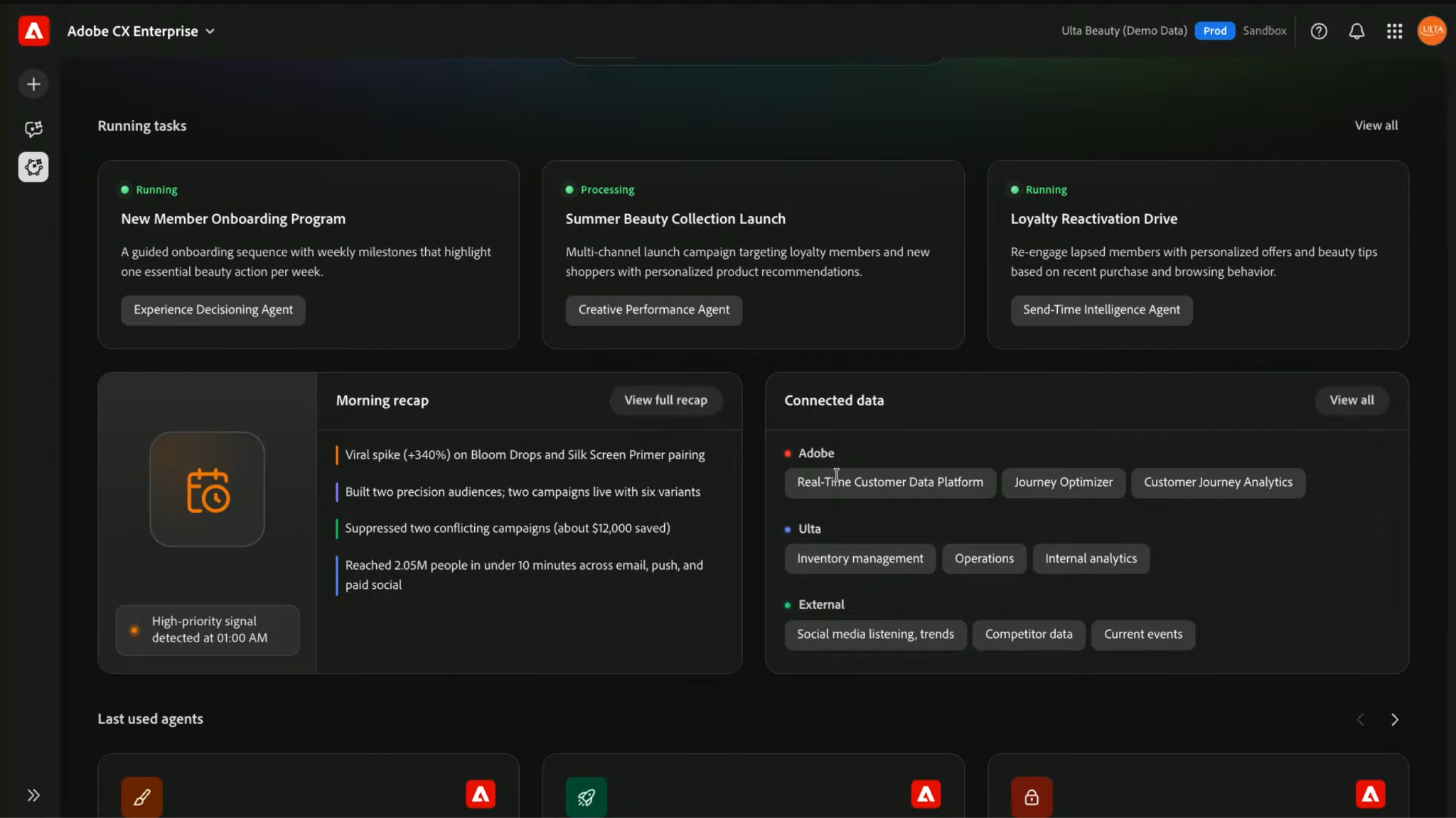
Demo of CX Enterprise Coworker for Ulta Beauty
You can also deploy agents to other places. For example if you are using ChatGPT Frontier, or MS Copilot as a central ‘home’ for your agents - you can have your Adobe marketing agents appear there. This is why I lost the bet.
Creating a ‘headless’ version of a software product for use in other (maybe competitor) products is a brave move, and also a cool bet on the future. This composability and flexibility is not something I was expecting to see so soon from Adobe, and the scale of how it is incorporated across their products is really impressive.
Agentic workflows for marketing
Another example of how agents can be chained together to achieve a goal was shown in a ServiceNow demo - automating creative production from brief to launch. From a campaign brief, the ‘Creative Production Agent’ built a production plan, sourced assets, and applied brand guidelines.
In this scenario a validation layer then flagged and fixed non-compliant assets, and a ‘Predict Engagement’ skill ran simulations against synthetic audiences to forecast how well the campaign would perform.
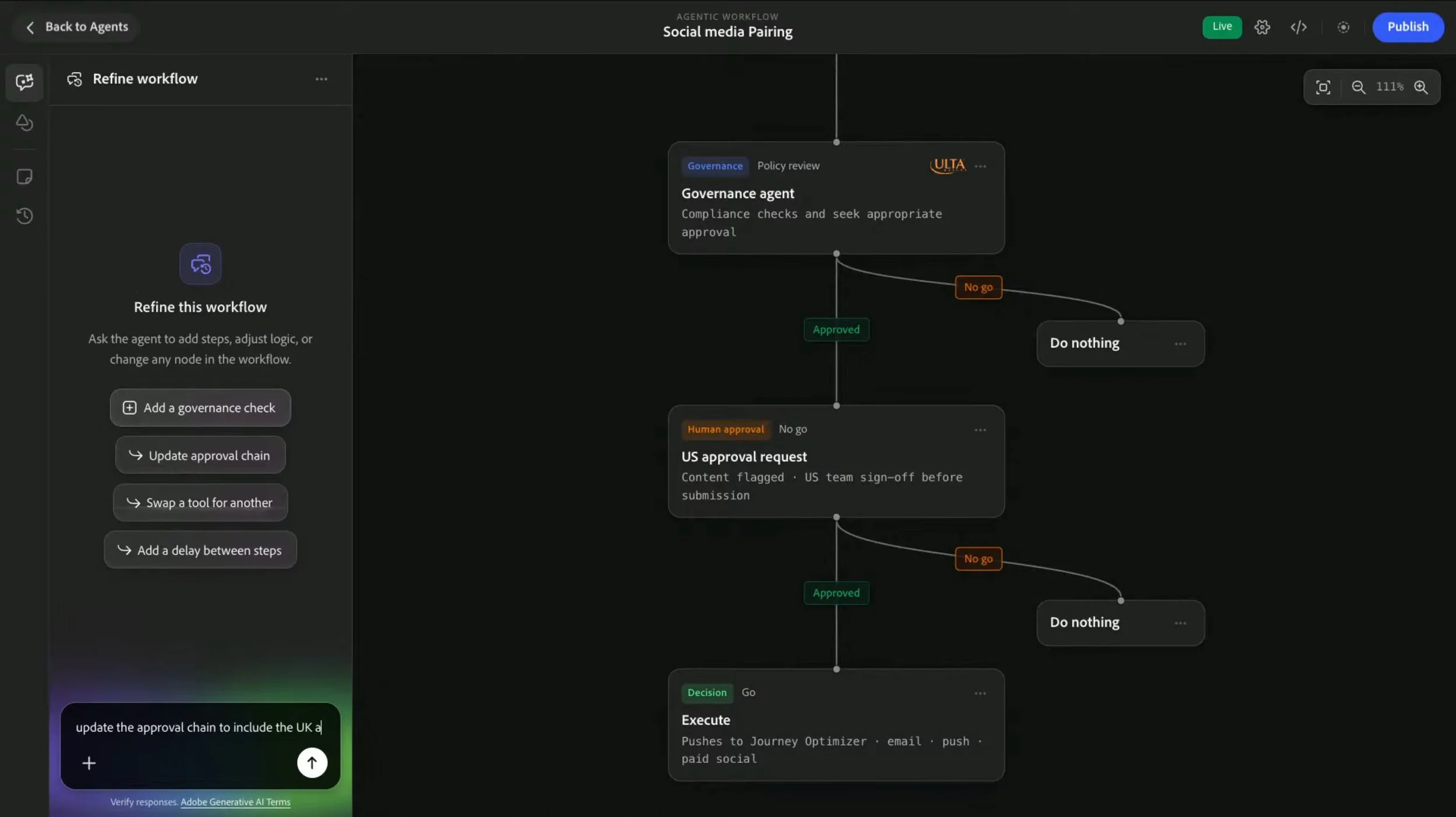
Demo of an agentic workflow in Adobe CX Enterprise
Walmart gave an example of how they are using their marketing infinity machine to automate content creation - in particular product launch campaigns - which has increased the volume of content they create by 49% and this has resulted in an eCommerce conversion increase of 8%.
After two days of keynotes and demos, my head was spinning. Adobe have woven generative AI into nearly all corners of the Experience Platform, plus also launched new AI-powered products (e.g. Brand Intelligence).
Speaking to other attendees they felt the same way - with the question being where to begin?
AI adoption for marketing teams
In this way, I think it’s strikingly similar to where a lot of companies are with adoption of AI more broadly. The aspiration (as a client put it to me today) is to go “from AI literacy to AI fluency” - and they need help with this transition.
With the new product range from Adobe, marketing teams will need help identifying which of their manual workflows are best suited to be agents or skills, and also assistance with building these and deploying them.
These workflows are different from those you would typically build in ChatGPT, Claude etc. And this is the advantage that Adobe are pressing. If you are using Adobe Experience Platform, you can now use CX Enterprise to create agentic workflows that span across your martech stack.
“AI Agents are the user interface of the future”
Adobe are smartly repositioning themselves from being a legacy software company (personally, I have been using Adobe products for 30 years!) to lead the way with AI and agentic platforms. That Adobe’s CEO is good buddies with Jensen Huang (founder and CEO of NVIDIA) is a good way to keep in touch with where things are heading!
In fact, one of the highlights for me of the Adobe Summit was seeing Jensen live on stage in the Day One keynote. He is one of the world’s biggest cheerleaders for AI (any why not, NVIDIA became the highest valued company in history this week!), and as he said in his keynote “AI Agents are the user interface of the future”.
Adobe are moving quickly to embrace this. But there is still a question as to whether the companies that buy the software can move at the same pace.
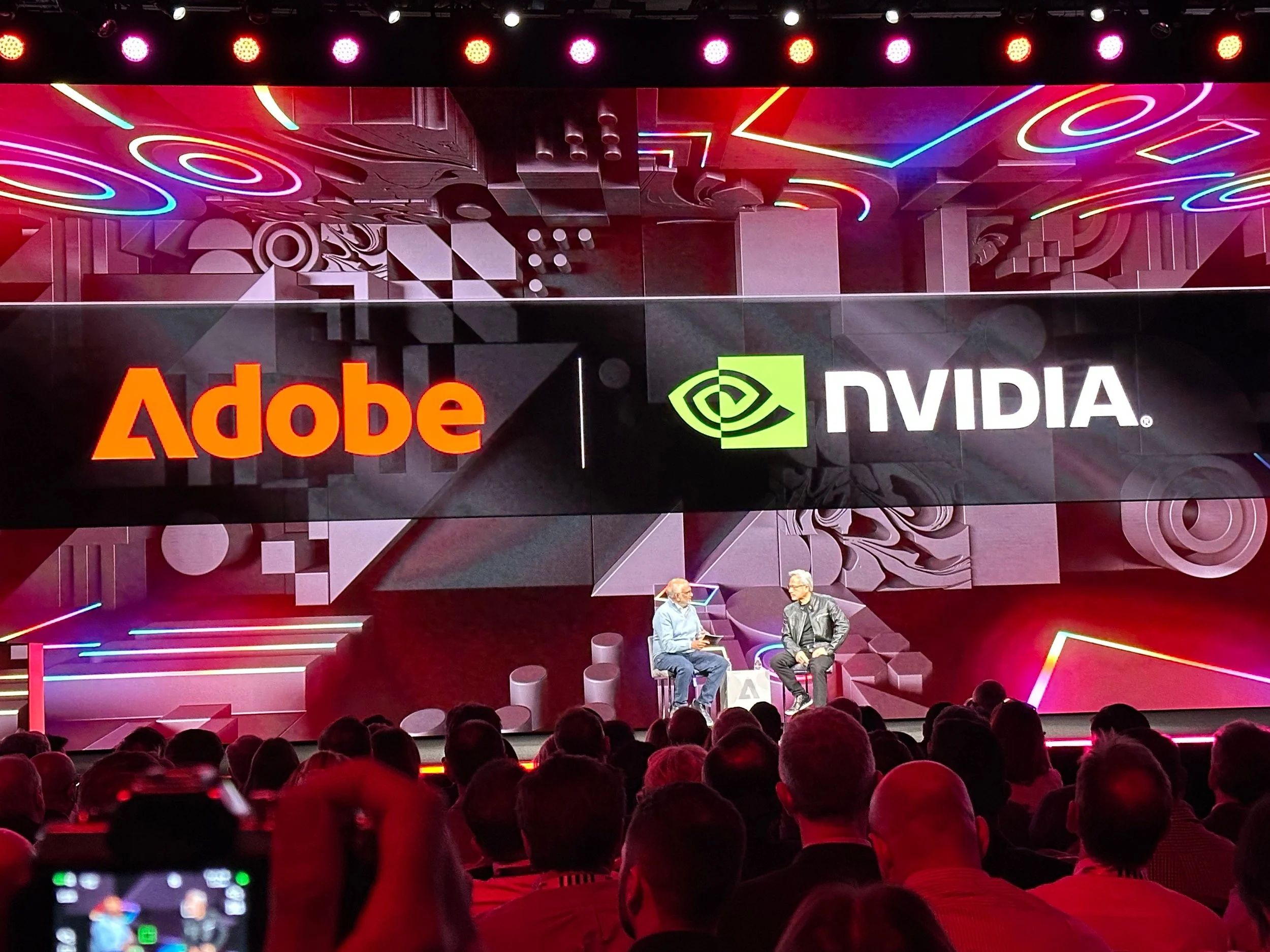
My photo of Jensen Huang on stage at Adobe Summit
There will be a lot of work for companies that use Adobe Experience Platform to understand how CX Enterprise fits within their existing martech stack, and once that is solved to identify which AI Agents to build, how to build them, and how to operate them.
Not to mention consideration for the people in the teams, and the change that platforms like this will have on their roles moving forward.
The Procter & Gamble CEO was right, you can no longer meet content demand with humans alone. But that’s not a reason to stop thinking humanly. The companies that get the most from a marketing infinity machine won’t be the ones who automate the most, they’ll be the ones who are clearest on what still needs a human hand.