✨ Collective Predictions 2026
Every year, we ask the talented Collective to do something simple and difficult:
Ignore the noise. Name the shift. Say it plainly.
Collective Predictions 2026 brings together operators, builders, strategists, and creatives to surface the changes that are already underway, but not yet fully acknowledged.
Below are the 10 collective predictions for 2026, grounded in the signals we’ve been witnessing in 2025.
Theme 1: Software stops being a product
Apps are becoming situational. In 2026, software assembles around intent, completes the job, then dissolves. The “product” isn’t the interface, it’s the momentary capability. If apps are generated on demand, then roadmaps, backlogs, and “features” get replaced by outcomes. The winners don’t ship apps, they ship reliable execution.

Collective voices
Jason says… software stops being “installed” and becomes something that self-generates for a moment of need—then disappears, reshaping dev work into one of many fundamentally changed roles.
Steph predicts… vibe coding grows up: AI dev agents become the default way web products get built, letting non-technical leaders ship faster/cheaper and making hand-coding feel like a legacy craft.
2025 signals
Agents can now act through a virtual computer - OpenAI’s ChatGPT Agent operationalises end-to-end task completion by operating a computer + tools, not just answering questions.
Replit Agent positions “tell it what you want, it builds it” as mainstream productised workflow.
Theme 2: Organisations become agentic
Agents don’t just help individuals, they become workforce units. Organisations start redesigning roles, metrics, and operating models around human + agent collaboration. The org chart becomes a capacity map: humans for judgment, agents for throughput. Companies that can’t govern mixed workforces will ship chaos at scale.

Collective voices
Julie reflects… companies re-architect around agents as first-class contributors—blending People + Tech leadership, merging KPIs/performance systems, and pushing humans up into strategy/creativity/relationships.
Bradley predicts… Google ships an AI-native device/OS fused with Workspace, making the assistant the operating layer of work and normalising AI as a workplace contributor.
2025 signal
Workday launching an “Agent System of Record” to govern/manage/optimize AI agents alongside people is a strong proof that core HR infrastructure is being rebuilt for a mixed human + agent workforce.
OpenAI positioning “ChatGPT agent” as something that plans and executes complex workflows end-to-end (using a virtual computer) signals agents moving from copilots to throughput-producing workforce units.
Theme 3: Humans-on-the-loop
Humans stop doing the work and start supervising outcomes. The loop doesn’t disappear, it moves upward into approvals, exception handling, and accountability. “Manager” becomes a literal job description again, except you’re managing non-human execution. The new failure mode isn’t error; it’s unnoticed error at speed.

Collective voices
David S says… we move from babysitting chatbots to supervising autonomous vertical agents doing drudge work end-to-end—shifting from paying for seats to paying for outcomes, with humans in judgment/strategy.
2025 signal
Supervision is now a shipped default: ChatGPT’s agent includes explicit permission/confirmation for consequential actions and “Watch Mode” oversight for critical steps, embedding approvals and takeover into execution.
Economics are shifting from seats to work: Microsoft Copilot Studio meters agents via usage-based “Copilot Credits,” nudging procurement toward paying for agent work/output rather than per-user seats.
Theme 4: AI becomes an advertising surface
When the assistant becomes the interface, the interface becomes the monetisation layer. “Helpful” is about to be quietly tuned by revenue. The clean chat UI gets messy. Answers become inventory. And neutrality will become something you pay for.
Collective voices
Tim O predicts… default assistants embedded into browsers make “distribution = destiny,” triggering platform power fights and antitrust heat.
Josh Rowe predicts… the AI invoice arrives: chat interfaces clutter with ads/affiliates, distribution crushes subscription rivals, and AI becomes invisible plumbing dominated by vertical specialists.
2025 signal
Ads are now being inserted directly into the “answer surface” (e.g., Google’s documented Ads in AI Overviews), turning responses into monetizable inventory.
When AI summaries appear, clicks drop sharply (Pew found users clicked traditional results in 8% of visits with an AI summary vs 15% without), showing “answers” cannibalising referral traffic.
Theme 5: Trust becomes expensive
As AI content floods everything, confidence in “what’s real” becomes harder to maintain. People retreat to smaller, private, governed systems — and pay for assurance. Trust stops being a vibe and becomes infrastructure: provenance, audit trails, and guardrails. If you can’t prove it, you can’t sell it.
Collective voices
David R warns… “helpful” assistants morph into ad channels that invisibly steer choices, triggering a trust collapse and driving demand for paid, private, auditable models with provenance/guardrails.
2025 signals
Provenance is becoming default plumbing: C2PA “Content Credentials” is being adopted by major players (including OpenAI) to attach cryptographic origin/edits metadata so buyers can verify what’s real.
Guardrails are becoming mandatory plumbing: OWASP and national cyber guidance now rank prompt injection in agentic systems as a top risk, forcing auditable safeguards and monitoring rather than “just trust the assistant.”
Theme 6: AI finds its voice
We’re moving from typing to talking, because voice is the most natural interface humans have. When it feels instantaneous, it stops feeling like software. Once voice becomes indistinguishable, every interaction becomes a brand interaction, and every brand interaction becomes automatable.
Collective voices
Aish jokes… emotionally savvy assistants spill into everyday life—fridges as persuasive late-night life coaches—where voice + personality makes AI ambient and persuasive.
Tim F predicts… sub-200ms voice makes AI conversationally human, enabling empathetic, memory-bearing phone agents at scale (support, tutoring, therapy, etc.).
Jackson predicts… Google vs OpenAI rivalry intensifies, but the bigger shift is multimodality maturing into one unified interface replacing the “tool zoo.”
2025 signals
OpenAI’s Realtime API supports low-latency, speech-to-speech interactions (including WebRTC/SIP), making “talking to software” a deployable default—especially for phone-based agents at scale.
Amazon’s Alexa+ is shipping commerce automation features (like monitoring deals and auto-buying), showing how voice-driven “brand interactions” can become automated actions.
Theme 7: Your customer is an agent
Shopping shifts from humans browsing to agents negotiating the path: discovery → evaluation → purchase. Decisions happen upstream, invisibly. Marketing becomes machine-readable. The new shelf space is the agent’s shortlist, and you don’t get a second page.
Collective voices
Basil predicts… commerce shifts upstream as agents discover/evaluate/buy for us—making machine-readable product truth more valuable than branding, and AI discovery the new battleground.
2025 signals
OpenAI’s ChatGPT is moving beyond recommendations into transactions with Instant Checkout and an Agentic Commerce Protocol, making the “new shelf” the agent’s shortlist rather than a human browsing results pages.
Google is baking the assistant into the browsing layer via agentic checkout in Search (and related “AI does the legwork” flows), collapsing discovery → comparison → action into a single agent-mediated journey.
Theme 8: The creative stack collapses
Idea → production → distribution compresses into one continuous loop. Tools converge, iteration accelerates, and “creator” expands beyond creative roles. The differentiator isn’t access to tools, it’s taste, direction, and control. Output explodes; meaning becomes scarce.
Collective voices
Adrian argues… AI filmmaking becomes an arms race of all-in-one production platforms; instant iteration, agents inside workflows, premium on character consistency + granular human control.
Dan says… culture flips: “that looks AI-made” becomes a compliment; “AI-enhanced” services get marketed (even in healthcare), possibly with ratings/league tables.
Simon predicts… “bananas, VEOs and vibes” make everyone a creator at work; creativity stops being gated by title/skill and is mostly limited by imagination + having something worth saying.
David Gill says… studios mainstream AI pre-production while actors adopt performance analytics—democratising blockbuster tooling and forcing Hollywood toward augmentation over full automation.
James Noble predicts… the “cost of imagination” collapses as cheap high-performance models unlock a new creative economy, shifting creative gravity from institutions to makers everywhere.
2025 signals
Creation is collapsing into a single “creative OS” loop: tools like Google Flow (Veo/Imagen/Gemini) and ElevenLabs’ Image & Video hub pull ideation→generation→iteration (plus audio) into one continuous workflow.
Distribution platforms are absorbing production: Meta and TikTok are moving toward “give us an image/brief + budget and we’ll generate and deploy the ad,” turning creative into an always-on optimisation loop inside the channel.
Theme 9: Skills become the bottleneck
The tech is moving faster than people. In 2026, capability gaps aren’t about models, they’re about literacy, adoption, and organisational change. If you can’t skill your workforce, you don’t get leverage, you get chaos. Training becomes strategy.
Collective voices
CJ reflects… after the model-training wave, 2026 becomes about talent training—because adoption is change management and teams must unlearn old habits for transformation to land.
2025 signals
Microsoft’s 2025 Work Trend Index says 81% of leaders expect AI agents to be integrated into their AI strategy in the next 12–18 months while employee familiarity lags, so the constraint shifts to upskilling and change adoption, not model capability.
The EU AI Act explicitly requires deployers/providers to ensure a “sufficient level” of AI literacy for staff, making training a structural, ongoing organisational obligation rather than a one-off learning module.
Theme 10: Being human becomes the differentiator
As synthetic content saturates the world, “real” becomes valuable again, not as nostalgia, but as a competitive advantage. Human judgment, accountability, and presence become premium signals. Authenticity becomes an asset class.

Collective voices
Cat warns… 2026 is when the “benign progress” myth breaks: backlash, hollowed judgment, deepfakes/regulation—making responsibility, taste, and real-world presence the scarce trust signals.
2025 signals
Regulation is hardening “real vs synthetic” into compliance: the EU AI Act (Article 50) requires disclosure for deepfakes and certain AI-generated public-interest content, pushing accountability and provenance into default expectations.
Provenance is becoming platform plumbing: Content Credentials (C2PA) are moving from standards to distribution + capture infrastructure (e.g., Cloudflare preserving credentials, Sony in-camera authenticity), making provable authenticity a premium signal.
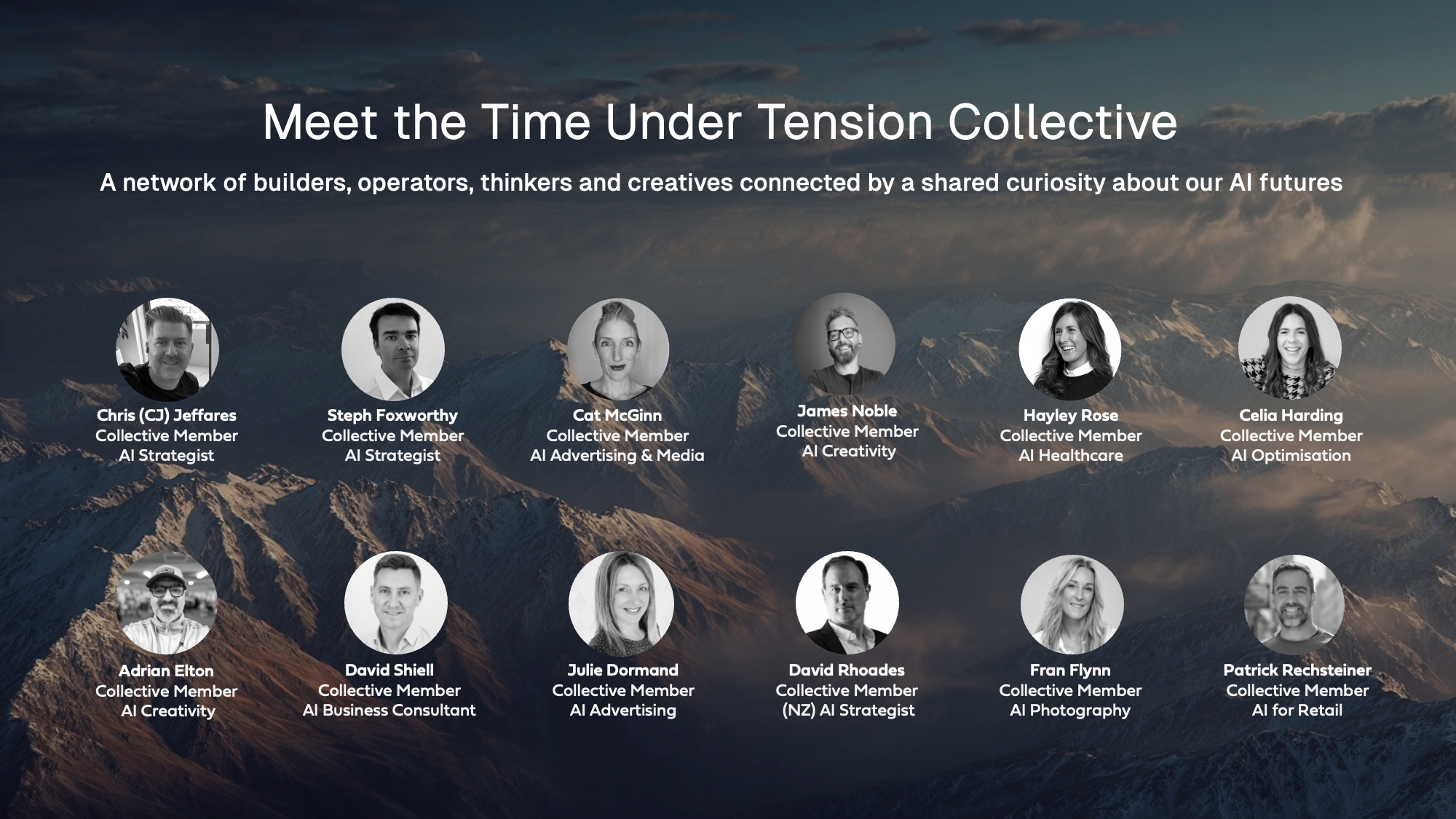
The Time Under Tension Collective
Meet the Time Under Tension Collective, a group of high caliber professionals, each bringing unique perspective to the generative AI landscape and part of our growing community of AI experts. This year we’re delighted to introduce you to the growing Collective team.